Knowledge base
Dust, Vapours or Gases: How to choose the right respiratory mask
Whether it concerns fine dust on a construction site, solvent vapours in the paint industry, or aggressive gases in the chemical sector, contaminated air requires the right respiratory protection. However, not every mask protects against every hazard. To make the right choice, it is essential to first determine exactly what you need protection against: dust and particles, gases and vapours, or a combination of both.
Step 1: Determine What You Need Protection Against
Before choosing a mask, you need to know what type of contaminant you are dealing with. In general, there are three situations:
- Particles and dust: for example fine dust, wood dust, cement dust or welding fumes.
- Gases and vapours: for example solvent vapours, ammonia or sulphur dioxide.
- A combination of both: commonly found in the chemical industry and during spray painting activities.
Each of these situations requires a different type of filter or mask. A particle filter does not protect against gases, and conversely, a gas filter does not provide protection against particles.
Protection Against Dust and Particles
For dust and particles, there are two options: a disposable dust mask (where the entire mask consists of filter material) or a separate particle filter fitted to a half-face or full-face mask. Particle filters fall under the EN 143 standard and are classified into P1, P2 and P3 categories. This is comparable to the FFP classes used for disposable dust masks under the EN 149 standard, with the same structure of protection levels:
- P1 / FFP1: light protection, up to 4 times the occupational exposure limit.
- P2 / FFP2: optimal protection against harmful dust particles, up to 10 times the occupational exposure limit.
- P3 / FFP3: maximum protection against toxic to highly toxic dust particles, up to 50 times the occupational exposure limit.
For occasional or short-term use, a disposable dust mask is often sufficient. For intensive or daily use, a half-face mask with a replaceable filter is often more comfortable and cost-effective in the long run.
Protection Against Gases and Vapours
Gases and vapours cannot be filtered with a particle filter. Instead, a gas filter compliant with EN 14387 is required. These filters are always used in combination with a half-face or full-face mask and can be identified by a letter and colour code:
Code | Colour | Protects against |
|---|---|---|
A | Brown | Organic gases and vapours (boiling point above 65°C), such as solvents |
AX | Brown | Organic gases and vapours (boiling point below 65°C), such as acetone |
B | Grey | Inorganic gases, such as chlorine and hydrogen sulphide |
E | Yellow | Sulphur dioxide and sulphuric acid |
K | Green | Ammonia and amine derivatives |
Each filter is also classified according to its capacity: Class 1 (0.1%) and Class 2 (0.5%). The higher the class, the longer the filter lasts and the higher the concentration against which it provides protection.
Combination Filters: Dust and Gas Protection in One
In many practical situations, dust and gases or vapours occur simultaneously, for example during spray painting operations or certain processes in the chemical industry. For these situations, combination filters are available, such as an A2P3 filter or the well-known ABEK filter (a combination of A, B, E and K protection).
Please note: a combination filter never protects against all substances at the same time and should not be used in changing work environments without reassessing the risks.
Half-Face or Full-Face Mask?
Besides the type of filter, the type of mask also plays an important role:
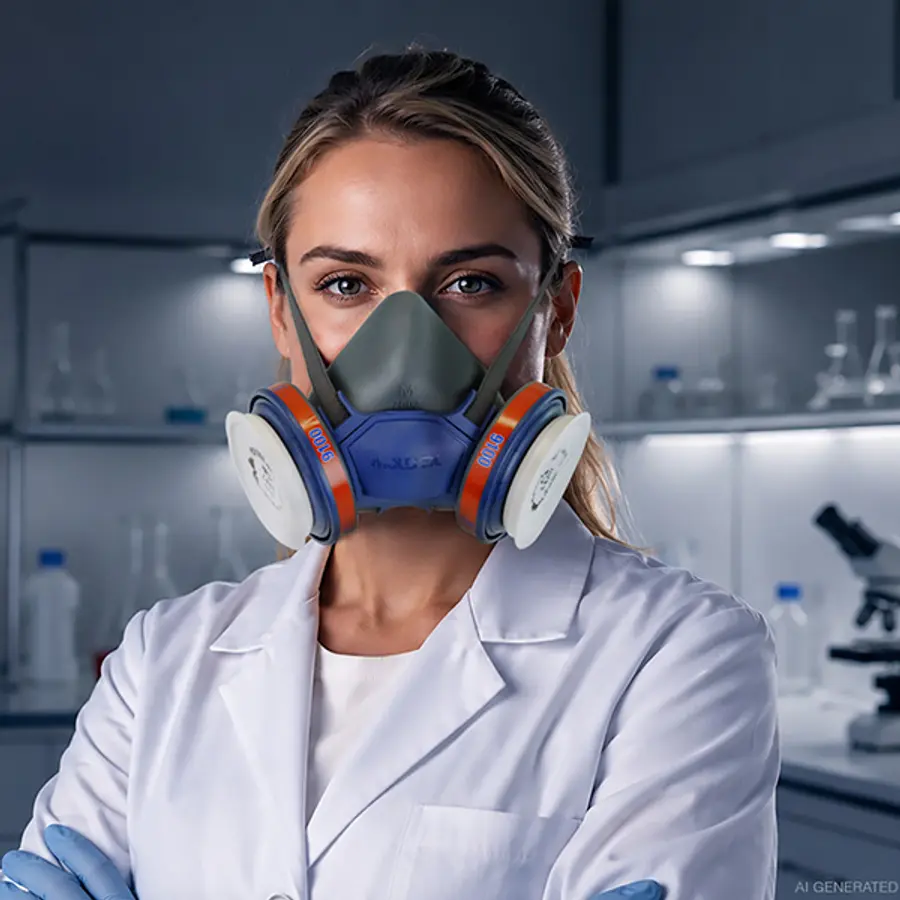
- Half-Face Mask: Covers the mouth, nose and chin and is used with replaceable filters. Suitable for most applications where eye protection is not required or can be provided with safety glasses.
- Full-Face Mask: Covers the entire face, including the eyes, and offers the best possible seal. Recommended for higher concentrations of contaminants or when eye protection is also required.
When Is Filter-Based Protection Not Enough?
All of the above solutions fall under dependent respiratory protection: they filter the surrounding air and therefore depend on the presence of sufficient oxygen in that environment (at least 19.5%).
In situations involving oxygen deficiency, very high concentrations of contaminants, or unknown substances, filter-based protection is not sufficient. In such cases, independent respiratory protection is required, such as a breathing apparatus or a system with its own compressed-air supply.
Need Advice?
The right choice depends on the specific substance, its concentration and the duration of exposure. Majestic offers suitable respiratory protection for every working environment from brands such as 3M, Moldex and MSA, ranging from disposable dust masks to complete half-face and full-face masks with filters.
Contact our specialists for expert advice tailored to your situation.