Knowledge base
EN 397 and EN 12492 – Which helmet should you choose for which work environment?
Whether you’re on a construction site, working in a factory, or performing tasks at height: head protection is a basic requirement. It therefore goes without saying that there are different types of helmets. Depending on the work being done, the risks change—and with them, the requirements for the helmet.
That is why there are different standards for head protection, of which EN 397 and EN 12492 are the most important. Both standards set clear requirements, but focus on entirely different types of risks. In this article, we clearly explain exactly what these standards entail and which helmet is best suited for which type of work.
EN 397 – Industrial helmet for protection against falling objects
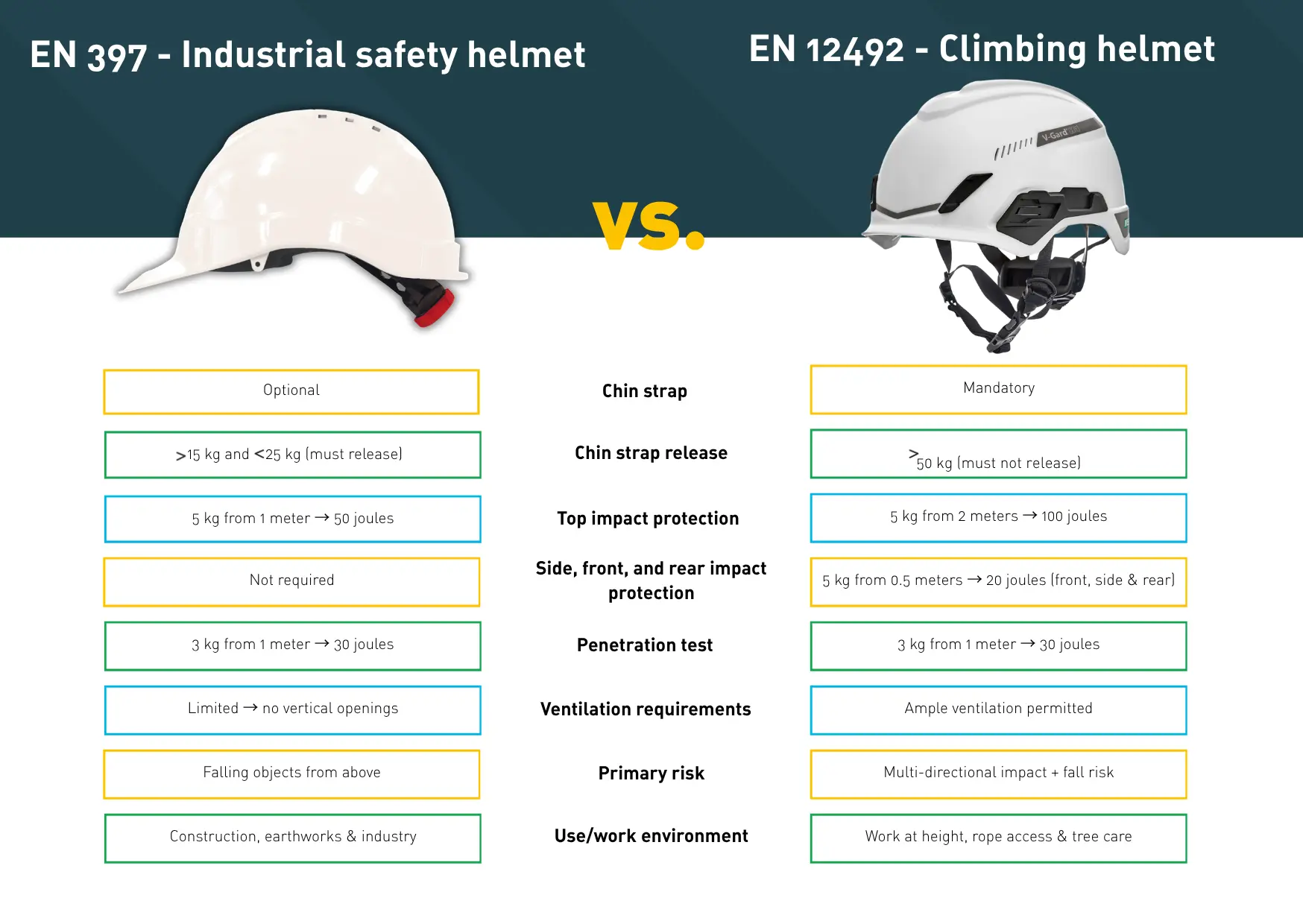
The EN 397 helmet is indispensable on construction sites and in industrial settings. This helmet is specifically designed to provide protection in work environments where the risk of falling objects is ever-present. The design is entirely focused on vertical impact and protection against sharp objects that may fall from above: think of falling tools, debris, loose material, or parts that may come loose during assembly.
Key features of EN 397
- Vertical impact protection: Designed to absorb impacts on the top of the helmet.
- Penetration resistance: Protection against sharp or pointed objects falling from above.
- Chin strap: The chin strap must release under a tensile force of 15–25 kg to prevent entrapment.
- Ventilation: Ventilation openings are permitted, provided they do not run vertically.
In practice, when should you choose EN 397?
EN 397 is widely used in sectors and environments where falling objects from above pose the greatest hazard:
- Ground-level construction sites: Workers who primarily work beneath structures, such as bricklayers, concrete workers, or carpenters, are at risk of falling objects from above—the primary reason for EN 397.
- Factories, industrial facilities, and warehouses: Falling materials from racks, machines, or equipment mean that vertical impact protection is a priority.
- Scaffolding at low to medium heights: In these situations, the risk of losing the helmet is limited, making the use of a detachable chin strap a responsible choice. Wearing a safety helmet with a short brim is preferred here, as it ensures good visibility and prevents the brim from obstructing the field of vision while working on the scaffold.
In short: wherever the greatest threat comes from above, EN 397 is the responsible choice.
EN 12492 – Climbing helmet for work at height and protection from all directions
The EN 12492 helmet was originally developed for climbing, but has since become the standard for professionals working at heights. The standard focuses not only on vertical impact, but specifically on situations where a helmet must provide protection from multiple directions: for example, in the event of a fall or unexpected movement.
Key features of EN 12492
- Multi-directional impact: Protection on the top, front, back, and sides of the helmet.
- Stricter penetration tests: Protection against sharp or pointed objects from multiple directions.
- Chin strap: Must not release under 50 kg of tensile force and therefore remains securely fastened during movement or a fall.
- Ventilation: Larger ventilation openings make the helmet suitable for intensive work.
When should you choose EN 12492 in practice?
EN 12492 is ideal when stability and protection from multiple directions are essential:
- Roofers: Workers move around a lot, bend, reach, and sometimes stand on sloped surfaces. A helmet that does not shift or fall off is essential.
- Rope access technicians and industrial climbers: While descending, climbing, or hanging, both the risk of falling and lateral impact are possible. The strong chin strap is indispensable here.
- Tree care: Falling branches, sideways impacts against the tree trunk, or swinging on ropes—this work requires multi-directional protection.
- Aerial work and mast work: The helmet must remain securely in place day in and day out, even in windy conditions, during movement, and in unexpected situations.
 EN 812 – Impact-resistant caps for low impact risk
In addition to the standards for safety helmets, there is also EN 812. This standard applies to impact caps, intended for situations where there is no risk of falling objects, but where there is a risk of the head striking low or protruding structures. An impact cap is therefore not a substitute for a safety helmet, but a lightweight, comfortable solution when only impact protection is needed.
When should you choose EN 812 in practice?
- Logistics environments and warehouse aisles
- Maintenance work in confined spaces
- Technicians working under machines or vehicles
- Workplaces with low-hanging parts or beams
Need help?
Whether working on the ground, at heights, or in confined spaces: the right helmet makes the difference between risk and safety. By carefully reviewing the standards, you can choose exactly the head protection that matches the risks in your environment. This helps prevent injuries, increases comfort, and ensures that every employee can do their job with optimal protection.
At Majestic, we’re happy to help you find the right solution. Looking for personalized advice or a tailored recommendation? Our enthusiastic team would love to tell you more!