
News
Top 5 metal-free safety hoes
When should you choose them – and when shouldn’t you?
Metal-free safety shoes are becoming increasingly popular. They’re lightweight, comfortable to wear and ideal for workplaces with security scanners or environments where electrical safety matters. But does metal-free automatically mean better? No. It simply means the shoe is constructed differently — and therefore better suited to certain types of work.
Want to know what metal-free safety shoes really are, when to choose them and when steel is still the smarter option? Keep reading.
What is a metal-free safety shoe?
A metal-free safety shoe contains no metal components at all. That means no steel toe cap, but a toe cap made from composite, fibreglass or modern nano-materials; no steel midsole, but a flexible, metal-free midsole that protects against sharp objects; and often no metal parts in laces, eyelets or fastenings either — these are replaced by lightweight alternatives.
Important to know: a metal-free shoe is just as safe as a shoe with steel, as long as it meets European safety standards. The safety doesn’t come from the material itself, but from the way the shoe is engineered and tested.
Why do many people choose metal-free?
- No issues with security scanners
In sectors such as security, logistics, distribution centres or airports, you pass through detection systems all day long. No alarms, no delays — simple and efficient. - Less sensitivity to cold
Metal conducts cold quickly. Composite or nano toe caps don’t. So if you work outdoors or in cooled areas, your feet often stay warmer and feel more comfortable. - Lighter and more flexible
Modern metal-free toe caps and midsoles are lighter and more flexible. You feel the difference especially on long workdays with lots of walking, bending or kneeling. - No conduction risk when working with electricity
When working near electrical installations, metal can pose additional risks. Metal-free shoes don’t conduct electricity, making them popular among electricians, technicians and maintenance teams. - More and more choice
Metal-free shoes are no longer a niche. At EMMA you’ll find high and low models, versions with or without DISC fastening, sporty or classic styles — including models from collections such as E-BOUNCE, CrossForce, Evoke/Everon and various sporty sneakers.
Why metal-free is not always the best choice
Metal-free works extremely well — but not everywhere. In some conditions, steel still has clear advantages.
- Slightly thicker toe cap
To offer the same protection as steel, composite or nano toe caps sometimes need to be slightly thicker. You usually don’t notice it, but if you already have limited toe space, the difference can be noticeable. - In heavy industry, steel is still necessary
Under extreme impact, heavy load or tough industrial work, professionals still choose a steel toe cap and/or steel midsole. Not because metal-free is unsafe, but because steel performs better in these specific conditions. - Sometimes a slightly higher purchase price
The materials and production techniques for metal-free shoes are often more advanced, which can make them a little more expensive.
In short: metal-free doesn’t replace steel, but it’s a smart choice for work situations where lightweight, flexibility or trouble-free passage through detectors is important.
When to choose metal-free — and when to choose steel?
Choose metal-free when:
- you frequently pass through metal detectors
- you work in security, logistics, distribution or airports
- you work outdoors or in colder environments
- you value lightweight and flexible footwear
- you work near electrical installations where metal is undesirable
Choose steel when:
- you work in heavy industry
- you deal with extreme impact or heavy loads
- you prefer the feel and space of a traditional steel toe
Tip: combine with the right sock
Metal-free safety shoes work even better when combined with the EMMA Hydro Dry® Sustainable Working Sock. This sock contains additional conductive (ESD) properties, helping to safely dissipate electrostatic charge. In combination with ESD safety shoes, this forms a safe and reliable solution.
Our top 5 safety shoes for warm and dry feet
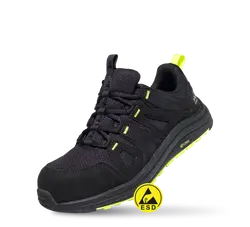 E-BOUNCE Black/lime
With E-BOUNCE you combine sporty comfort with metal-free safety. The lightweight shoe feels energetic thanks to its responsive sole, which absorbs impact and returns energy with every step. The metal-free construction lets you pass security gates without any delay, and with S1PS protection and extreme grip, it’s an ideal shoe for logistics, order picking and production halls where you cover many steps each day.
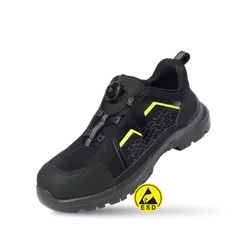 Crossforce Flex
Crossforce Flex gives you stability and freedom of movement in one. The metal-free toe cap and midsole make the shoe flexible and surprisingly light, without compromising safety. The DISC closure is a safe alternative to laces, easy to operate with one hand and quick to put on and take off. The ESD properties make it suitable for environments where electrostatic discharge control matters. Perfect for warehouses, assembly work and distribution centres.
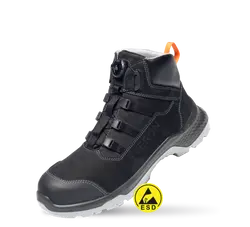 Everon 2.0 DISC
Everon 2.0 DISC is built for speed and comfort. Thanks to its metal-free construction, the shoe feels light and smooth — ideal for jobs with lots of walking or bending. ESD protection prevents unwanted static discharge, and the DISC system allows fast, even tightening. Combined with a breathable upper and solid S3S protection, this is a smart choice for modern logistics, technical services and high-security locations.
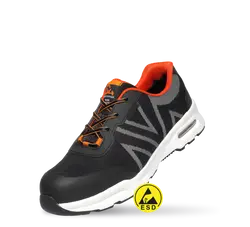 Boston
Boston is a sporty safety shoe that looks like a sneaker but performs like a work shoe. The metal-free toe cap and midsole keep the weight low and allow natural foot movement. This makes Boston ideal for technicians, warehouse staff and anyone looking for a smooth, flexible shoe that won’t trigger security scanners.
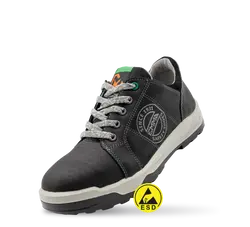 Clay
Clay
Clay is a sturdy yet comfortable work shoe that, thanks to its metal-free protection, feels lighter than traditional models. The flexible sole moves naturally with the foot, and its ESD protection makes it suitable for environments with sensitive equipment or electrostatic risks. A practical choice for logistics, light industry and jobs that require plenty of walking.